
AC/DC DC power supplies, as the core carrier of power conversion, are widely used in industrial control, precision electronics, new energy supporting and other scenarios, and their service life is directly related to the stability and operation and maintenance costs of the entire power consumption system. Thermal stress is the core inducement of power device aging, parameter drift and even complete machine failure. Conventional heat dissipation design can only achieve basic heat dissipation, but it is difficult to avoid long-term damage caused by thermal cycle impact and local heat accumulation from the source. Niche and refined thermal management design, which cuts in from multiple dimensions such as device selection, topology optimization and heat conduction structure innovation, has become the key path to extend the service life of AC/DC DC power supplies, allowing the power supply to always be in a safe thermal environment during continuous operation.
1. Source Heat Control: Reducing Heat Loss from Devices and Topology
The heat of AC/DC DC power supply is mainly generated in the power conversion link. The superposition of switching loss and conduction loss will make the junction temperature of power switching tubes, rectifier diodes and other devices rise rapidly. For every 10℃ rise in junction temperature, the service life of semiconductor devices will be halved. The niche source heat control idea abandons the traditional method of simply improving heat dissipation capacity, and instead controls the source of loss generation. In terms of device selection, wide band gap semiconductor devices such as silicon carbide MOSFETs are selected, which have faster switching speed and lower on-resistance, and the switching loss under the same power is reduced by more than 60% compared with silicon-based devices, fundamentally reducing heat generation. At the same time, thick film resistors and ceramic capacitors with stable high temperature characteristics are used to replace electrolytic capacitors that are susceptible to temperature, avoiding the problem of increased capacitor leakage current with rising temperature.
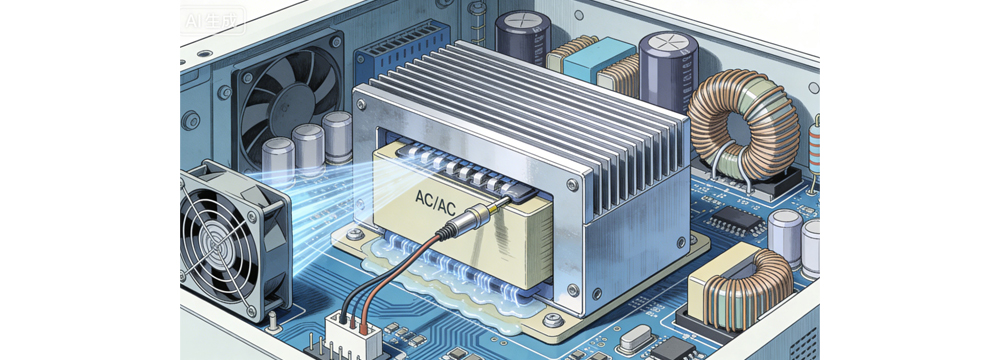
In the topology design, the architecture combining interleaved PFC topology and soft switching LLC resonant topology is adopted. The interleaved PFC can reduce the input current ripple and the magnetic loss of the inductor, while the soft switching technology allows the power device to complete on and off in the zero voltage or zero current state, greatly reducing the switching loss. Through source heat control, the overall loss of the AC/DC DC power supply is controlled at a low level, reducing the pressure for subsequent thermal management, which is the foundation for extending the service life of the power supply.
2. Global Thermal Uniformity: Avoiding Hidden Damage from Local Heat Accumulation
Most conventional thermal management designs focus on the heat dissipation of core heating devices, but ignore the thermal gradient problem caused by local heat accumulation. The temperature difference between different devices inside the power supply will cause thermal stress, leading to hidden damage such as solder joint cracking and packaging material aging, which is also the key reason why many power supplies seem to have good heat dissipation but fail in advance. The niche global thermal uniformity design emphasizes the uniform distribution of heat inside the power supply, and achieves dead-angle-free heat conduction through structural optimization.
In PCB layout, thick copper cladding and thermal via array design are adopted, so that the heat of heating devices is quickly conducted to the entire PCB board through copper skin, rather than concentrated in local areas. For magnetic components such as isolation transformers and high-frequency inductors, ferrite cores with low magnetic loss are selected, and high thermal conductivity silica gel is filled between the winding and the skeleton to improve the heat dissipation efficiency of magnetic components and avoid them becoming local heat sources. At the same time, a micro heat conduction bracket is set inside the power supply to thermally connect heating devices such as power devices, magnetic components and rectifier bridges with the metal shell, making the shell a global heat sink, realizing the homogenization of the internal temperature of the power supply, eliminating the hidden damage caused by thermal gradient, allowing all devices to work in the same thermal environment, and greatly reducing the failure probability caused by thermal stress.
3. Adaptive Heat Dissipation: Dynamic Thermal Management Matching Working Conditions
The working conditions of AC/DC DC power supplies are not constant. Changes in load rate and input voltage will cause large fluctuations in heat generation. Fixed heat dissipation design causes waste of heat dissipation resources at light load, and it is difficult to meet heat dissipation requirements at heavy load. This mismatch will accelerate power supply aging. The niche adaptive heat dissipation design realizes the dynamic matching of heat dissipation capacity and power supply heat generation, so that the heat dissipation efficiency is always in the optimal state.
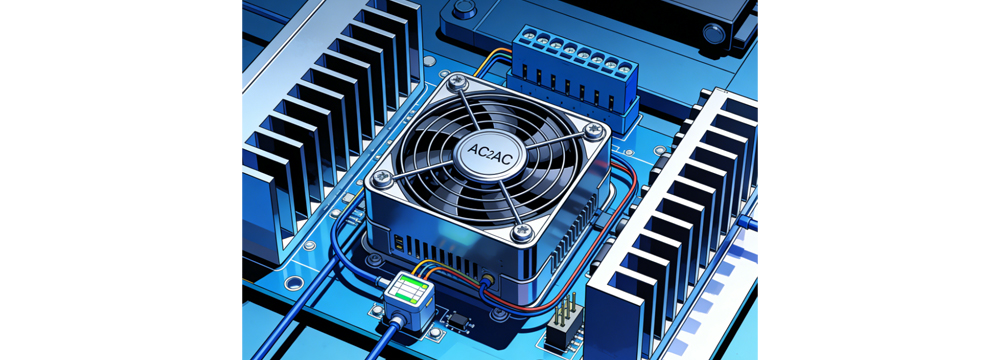
By setting a temperature sensor and a speed-regulating fan drive circuit inside the power supply, the junction temperature of power devices and the internal ambient temperature of the power supply are monitored in real time. When the load rate increases and heat generation increases, the fan automatically increases the speed to enhance forced convection heat dissipation; when the load rate decreases and heat generation decreases, the fan reduces the speed or even stops running, reducing the mechanical loss of the fan, and avoiding the condensation problem inside the power supply caused by excessive heat dissipation. For sealed power supplies without fans, phase change heat dissipation materials are used as auxiliary, which absorb heat by using the latent heat during material phase change, and quickly absorb excess heat when heat generation increases sharply to maintain the stable internal temperature of the power supply. Adaptive heat dissipation makes the thermal management design fit the actual working conditions of the power supply, avoids the service life loss caused by insufficient or excessive heat dissipation, and realizes the precise matching of heat dissipation and working conditions.
The service life of an AC/DC DC power supply is not determined by a single device, but by the thermal environment of the entire system. Abandoning the traditional extensive heat dissipation idea, adopting a niche and refined thermal management design combining source heat control, global thermal uniformity and adaptive heat dissipation, reducing heat loss from the source, avoiding thermal stress from the whole domain, and matching working conditions dynamically, so that all devices of the power supply always work in a safe temperature range, can fundamentally delay device aging, greatly extend the service life of AC/DC DC power supplies, and allow them to maintain long-term stable operation in various complex scenarios.
Share our interesting knowledge and stories on social media