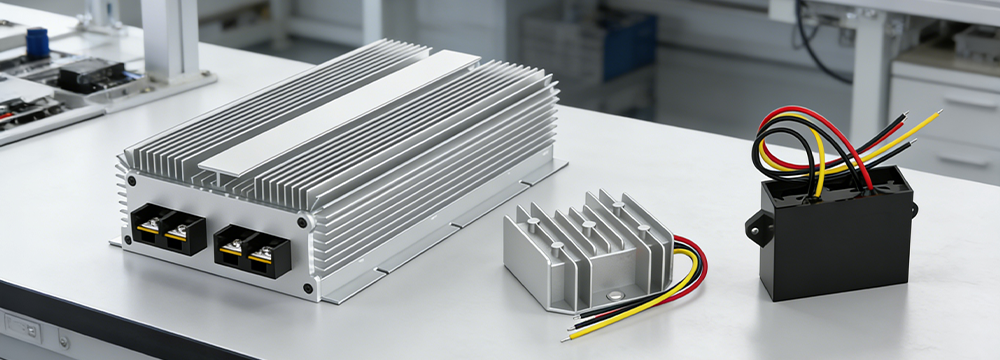
In high-end sectors including new energy storage, industrial control, new energy vehicles, and rail transit, high-power DC-DC converters serve as the core hub for power conversion and transmission, shouldering the critical tasks of stepping down, stepping up, and regulating high-voltage direct current. Their stable operation is critical to the safety and long-term reliability of the entire electronic system. Unlike medium and low-power DC-DC converters, high-power units are far more prone to overload and overheating issues due to their large output current, high power density and long-term high-load operation. Overload can directly damage internal power devices and cause circuit short circuits, while excessive temperature rise speeds up the aging of core components like capacitors and MOSFETs, lowering power conversion efficiency. In serious cases, it may even trigger thermal runaway, leading to cascading failures and heavy economic losses for enterprises. Therefore, scientifically preventing overload and overheating is a core focus in the design, debugging, operation and maintenance of high-power DC-DC converters, and a key prerequisite for ensuring the stable running of downstream equipment.
I. Clarify Failure Causes to Lay a Solid Foundation for Prevention and Control
To prevent overload and overheating failures, the first step is to accurately identify their core causes. Only by finding the root problems can we develop and implement targeted and precise preventive measures. Overload failures mainly stem from two core scenarios: first, abnormalities at the load end, such as short circuits in downstream equipment or sudden load changes exceeding the converter's rated output power range, causing a sudden surge in input and output current beyond the device's tolerance limits; second, design or setting flaws in the converter itself, such as unreasonable parameter matching, lack of overload protection mechanisms, or insufficient sensitivity, preventing timely detection of overload signals and rapid disconnection of the output circuit, ultimately leading to device damage. The formation of overheating faults is mainly closely related to energy loss and insufficient heat dissipation: in high-power DC-DC converters, the switching losses of switching devices, copper and iron losses of transformers, and losses of filtering components continuously generate a large amount of heat during the power conversion process. If the heat dissipation design is inadequate, the heat cannot be dissipated in time, leading to a continuous increase in internal temperature; at the same time, external factors such as excessively high ambient temperature in industrial environments, dust accumulation blocking heat dissipation channels, and insufficient installation spacing will further exacerbate the overheating problem, forming a vicious cycle of "heat accumulation—increased loss—sudden temperature rise," ultimately inducing failure.
II. Optimizing Circuit Design and Strengthening Overload Prevention and Control
Optimizing circuit design and establishing a comprehensive overload protection system are core methods to avoid overload faults from the source and are key to improving the operational reliability of high-power DC-DC converters. On the one hand, it is necessary to accurately match power parameters. Based on the rated power and peak power of the downstream load, the rated output power of the converter should be reasonably set, and a power margin of 15% to 20% should be reserved to prevent the converter from operating under full load or overload conditions for a long time, fundamentally reducing the risk of overload. On the other hand, integrate multiple redundant overload protection functions, focusing on configuring three core modules: overcurrent protection, overpower protection, and short-circuit protection, coupled with high-precision current sampling chips and fast response circuits to monitor the dynamic changes of input and output current and power in real time. When the detected current and power exceed the preset rated threshold, the protection circuit needs to trigger a response within milliseconds, quickly blocking the overload impact by cutting off the output circuit, reducing the output power, or shutting down the device to prevent component burnout. In addition, an intelligent overload early warning mechanism can be introduced. When the load power approaches the rated threshold, an audible and visual warning signal is issued in time to remind operators to adjust working conditions and reduce the load, achieving early prevention and control of overload faults.
III. Upgrading Heat Dissipation Solutions to Suppress Overheating Faults
Strengthening heat dissipation design and reducing operating temperature rise are key measures to prevent overheating failures. To cope with the heat generated by high-power converters, we need to employ a combination of active and passive cooling solutions. For passive cooling, we use materials with good thermal conductivity, increase the heat dissipation area, optimize the PCB layout, and shorten the power circuit wiring to reduce heat accumulation. For active cooling, we use high-efficiency cooling fans and liquid cooling systems, and employ intelligent temperature control modules to monitor the internal temperature in real time and automatically adjust the operating status of the cooling equipment, thus avoiding wasting cooling resources required by high-power converters.
At the same time, we can optimize component selection, prioritizing low-loss, high-temperature-resistant wide-bandgap semiconductor devices to reduce heat generation during the power conversion process and thus lower the temperature rise.
IV. Standardized Operation and Maintenance, Strengthening Long-Term Guarantee
Standardized operation and routine maintenance are crucial guarantees for preventing overload and overheating failures. During operation, it is necessary to strictly follow operating procedures: avoid unreasonable operations such as frequent start-ups and shutdowns, sudden load changes, and ensure the converter operates stably within its rated parameters. Regularly conduct comprehensive inspections of the converter, clean dust and debris from cooling channels to keep heat dissipation smooth. Monitor the aging and wear of core components, and replace those with degraded performance in a timely manner to prevent overload and overheating failures caused by component aging. In addition, an intelligent monitoring platform can be set up to track the converter’s operating parameters and temperature changes in real time, so that faults can be detected, warned and handled early.
In summary, preventing overload and overheating failures in high-power DC-DC converters requires joint efforts in circuit design, thermal optimization, and operation and maintenance, to build a comprehensive prevention and control system integrating active prevention, passive protection and routine maintenance. As the application scenarios of high-power DC-DC converters continue to expand, the requirements for their operational stability are also continuously increasing. In the future, it will be necessary to combine intelligent control, new cooling technologies, and other techniques to continuously optimize prevention and control solutions, promoting the development of converters towards high reliability and low loss, providing strong support for the stable operation of various high-end electronic systems.
We at IDEALPLUSING not only provide products, but also strive to provide customers with suitable power supply solutions and quotations.
Our core competitiveness lies in carefully selecting a variety of power supply options to help customers evaluate and choose the most suitable power supply solution.
We can offer AC DC power supply, DC AC inverter, AC AC power source(single phase or 3 phases),AC DC Ground Power Unit...