
In the design system of AC/DC DC power supplies, conversion efficiency is one of the core indicators to measure product performance. As a key link in power hardware design, the rationality of PCB layout directly affects the loss control and efficiency performance of the power supply. Unlike popular optimization directions such as architecture selection and device parameter matching, the refined adjustment of PCB layout is a more niche and easily overlooked path to improve efficiency, but it can bring significant energy efficiency breakthroughs in practical applications.
1. Reduce Parasitic Parameters of High-Frequency Loops and Cut Down Switching Losses
The power conversion link of AC/DC power supplies relies on high-frequency switching actions. The rapid turn-on and turn-off of switching tubes and freewheeling diodes will generate parasitic inductance and parasitic capacitance in the loops formed by PCB traces. These parasitic parameters will cause voltage spikes and current oscillations, increasing switching losses. Especially in common topologies such as flyback and half-bridge types, the parasitic inductance of high-frequency loops has a more prominent impact on efficiency.
During PCB layout, it is necessary to specifically shorten the trace length of power loops, optimize trace width, and arrange the pins of switching tubes, transformer primary sides, and input filter capacitors as close as possible to build a high-frequency current loop with the smallest area. For example, directly connect the output end of the rectifier bridge and the drain end of the main power switching tube through wide copper cladding to reduce trace impedance; at the same time, form a compact current loop with the freewheeling diode, transformer secondary side, and output filter capacitor to avoid excessive loop area leading to increased parasitic inductance. Through such layout optimization, voltage overshoot during switching can be effectively suppressed, the on-loss and off-loss of switching tubes can be reduced, and the conversion efficiency of the power supply can be indirectly improved.
2. Optimize Heat Dissipation Layout to Alleviate Efficiency Attenuation Caused by Device Temperature Rise
During the operation of AC/DC power supplies, the on-loss and switching loss of power devices will be converted into heat, causing the device temperature to rise. The on-resistance of core devices such as MOSFETs and diodes will increase with temperature rise, further aggravating losses, forming a vicious cycle of "temperature rise - increased loss - efficiency decline".
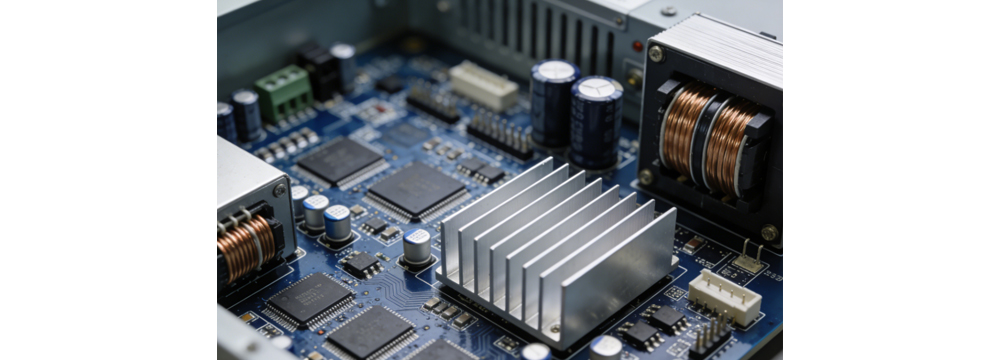
The heat dissipation optimization of PCB layout needs to start from two dimensions: one is to rationally plan the device layout, disperse the arrangement of high-heat-generating switching tubes and rectifier diodes to avoid heat concentration; the second is to use PCB copper cladding and thermal vias to enhance heat dissipation capacity, design large-area copper cladding at the device pads, and conduct heat to the back of the PCB through multiple thermal vias to improve heat dissipation efficiency. For low-power power supplies, the top and bottom copper cladding can be connected to expand the heat dissipation area; for medium and high-power power supplies, hollow structures can be designed under the devices to achieve efficient heat dissipation with heat sinks. By reducing the operating temperature of the device, the stability of its electrical performance is maintained, and the efficiency attenuation caused by temperature rise is avoided.

3. Isolate Sensitive Signals and Avoid Losses Caused by Electromagnetic Interference
The control loop of AC/DC power supplies is sensitive to electromagnetic interference. If the power loop and control loop traces overlap in the PCB layout, high-frequency power signals will interfere with the accuracy of control signals through electromagnetic coupling, leading to distortion of PWM modulation signals, offset of switching tube turn-on and turn-off timings, and increased additional losses.
During layout, it is necessary to strictly isolate the power area from the control area, and reduce electromagnetic interference by means of ground segmentation and shielded copper cladding. For example, centrally arrange control chips such as PWM controllers and optocoupler isolators on one side of the PCB, keeping a certain distance from the power device area; the traces of the control loop adopt short and straight design to avoid parallel traces with the power loop; at the same time, set grounded copper cladding around sensitive signal lines to form an electromagnetic shielding layer. By suppressing electromagnetic interference, the accuracy of control signals is ensured, the power supply works under the optimal switching timing, and the invalid losses caused by timing disorders are reduced.
4. Precisely Plan the Ground Layout and Reduce Ground Wire Impedance Loss
Ground design is the core point of PCB layout. Unreasonable grounding methods will increase ground wire impedance, generate ground voltage drop, and affect the voltage regulation accuracy and efficiency of the power supply. In AC/DC power supplies, grounding is divided into power ground and signal ground. If the two are mixed, the large current of the power loop will generate noise on the signal ground line, interfering with the normal operation of the control chip.
Adopt single-point grounding or star grounding method, connect the power ground and signal ground through a common grounding point to avoid large current flowing in the signal ground loop; at the same time, widen the ground wire width to reduce ground wire impedance, ensuring that the return current of the power loop can smoothly return to the negative pole of the power supply through the ground wire. For the sampling resistor at the output end, its ground end should be directly connected to the signal ground to reduce the ground noise of the sampling signal, improve the accuracy of feedback adjustment, make the output voltage of the power supply more stable, and further optimize the efficiency performance under light load and heavy load conditions.
In summary, PCB layout optimization is not a simple trace arrangement, but a systematic design work combining power topology characteristics, device electrical performance and electromagnetic compatibility requirements. Through niche adjustment methods such as reducing parasitic parameters of high-frequency loops, optimizing heat dissipation layout, isolating sensitive signals and precisely planning grounding methods, power supply losses can be effectively reduced and the conversion efficiency of AC/DC DC power supplies can be improved without increasing additional device costs, providing a practical solution for the energy efficiency upgrade of power supply products.
Share our interesting knowledge and stories on social media