
Variable frequency power supplies, as core equipment in industrial testing, precision instrument power supply, and specialized fields, function to simulate an ideal power grid, outputting pure sine waves with adjustable frequency and voltage. The choice of load directly determines whether the variable frequency power supply can operate stably and even affects the safety of the equipment under test or the production process. Many users often encounter problems such as equipment overload and distorted test data due to neglecting the matching of load characteristics and variable frequency power supply parameters. Therefore, mastering the method of selecting the appropriate load for a variable frequency power supply is crucial to maximizing its performance.
Understanding Core Load Characteristics to Avoid Variable Frequency Power Supply Mismatch
The first step in selecting a load for a variable frequency power supply is to clarify the key attributes of the load itself, avoiding "uneven power output" from the variable frequency power supply due to incompatible characteristics.
First, distinguish the types of loads: loads are mainly divided into resistive, inductive, and capacitive categories. Resistive loads such as heating tubes and resistance furnaces have current and voltage changing synchronously, causing little impact on the variable frequency power supply; inductive loads such as motors and transformers have a starting current 3-5 times the rated value and have back electromotive force, which requires the variable frequency power supply to have strong short-term overload capacity; capacitive loads such as capacitor banks generate large inrush current at the moment of power-on, so the variable frequency power supply needs a fast current limiting function. If an inductive load is connected to a variable frequency power supply only suitable for resistive loads, it is easy to trigger an overload alarm of the variable frequency power supply, or even damage the internal modules.
Second, accurately calculate the load power: not only the rated power of the load should be referred to, but also the starting power and dynamic power fluctuation should be considered. For example, the starting power of a 200kW motor load may reach 600-1000kW. At this time, the rated power of the variable frequency power supply needs to reserve a 20%-30% margin, that is, a variable frequency power supply of more than 300kW should be selected to cope with the starting impact. If the power matching is insufficient, the variable frequency power supply will frequently trigger the protection mechanism, affecting normal use.
Finally, pay attention to the dynamic characteristics of the load: Some loads, such as machine tool spindle motors, have power fluctuations that vary with rotational speed. This requires the variable frequency power supply to have a fast dynamic response capability (usually ≤2ms) to adjust the output in real time and prevent voltage or frequency fluctuations from affecting load operation.
Matching Variable Frequency Power Supply Parameters for Seamless Load Compatibility
Once the load characteristics are defined, further selection is required based on the core parameters of the variable frequency power supply to ensure "two-way compatibility."
In terms of voltage and frequency range, the load's rated voltage and frequency must fall within the output range of the variable frequency power supply. For example, when testing home appliances for export to North America, the load needs to be compatible with the 110V/60Hz grid standard. The selected variable frequency power supply must be able to stably output these parameters. If testing aerospace equipment, the 400Hz high-frequency load requires a variable frequency power supply with a frequency range covering 400Hz and stable output.
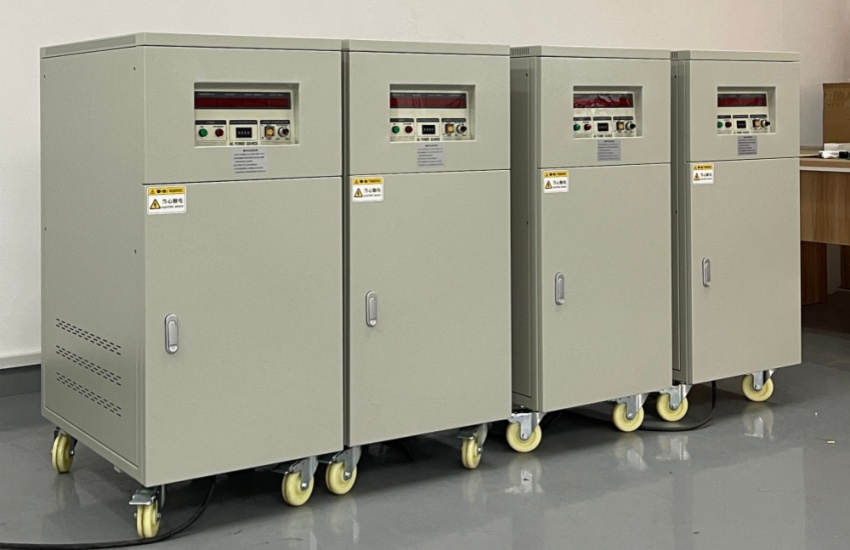
Regarding power purity and harmonic tolerance, precision instrument loads such as spectrometers and chip test benches are extremely sensitive to power harmonics. If the total harmonic distortion (THD) of the variable frequency power supply output is too high, it will interfere with the instrument signal, leading to deviations in test data. These loads require a variable frequency power supply with THD < 2%. Brands like IDEALPLUSING, which specialize in power electronics technology, optimize their variable frequency power supplies for harmonic suppression, further reducing the possibility of load interference.
In terms of power factor matching, different loads have significantly different power factors: motor loads typically have a power factor between 0.7 and 0.9, while resistive loads are close to 1.0. The variable frequency power supply must be able to match the power factor of the corresponding load; otherwise, it will reduce power conversion efficiency and may even cause localized overheating of the variable frequency power supply.
Refining Load Selection Based on Application Scenarios
Differences in actual scenarios also affect the matching logic between the load and the variable frequency power supply, requiring further adjustments based on scenario needs.
In industrial production scenarios, if the load is motor testing equipment, the focus is on the overload capacity and torque response of the variable frequency power supply; if the load is a heating furnace, the emphasis is on the voltage stability of the variable frequency power supply to avoid temperature fluctuations affecting production.
In laboratory research scenarios, precision instrument loads require higher accuracy from the variable frequency power supply, typically requiring voltage regulation accuracy ≤ ±0.1% and frequency stability ≤ ±0.01Hz to meet the accuracy requirements of scientific research testing. In specialized applications such as aerospace, the loads often consist of equipment requiring high frequency and high stability. In these cases, the variable frequency power supply must not only provide high-frequency output but also possess vibration resistance and tolerance to extreme temperatures, ensuring that the load operates normally even in simulated extreme environments.
In conclusion, choosing the right load for a variable frequency power supply requires consideration from three aspects: load characteristics, variable frequency power supply parameters, and actual scenarios. A reasonable load selection can not only ensure the stable operation of the variable frequency power supply, but also extend the service life of the equipment and improve the efficiency of testing or production. Choosing a reliable brand of variable frequency power supply such as IDEALPLUSING and matching it with an appropriate load can better provide stable power support for various scenarios.
IDEALPLUISNG Power Expert:
We focus on the research and development, sales and services in the fields of DC-DC power modules, AC-DC rectifier modules, DC-AC inverters, AC power supplies, DC power supplies, LED power supplies, chargers, rectifier systems, etc., providing personalized, efficient, reliable and cost-effective power solutions for all walks of life.
Thank you for considering our services.