In industrial power supply, energy storage systems, and rail transit, DC-DC converters are core devices for power transmission and voltage regulation, and their selection directly affects the safety and stability of the system. In most scenarios, non-isolated DC-DC converters initially attract attention due to their low cost and compact size. However, when high-voltage environments, sensitive loads, or operator safety are involved, the unique advantages of isolated DC-DC converters gradually become prominent. Different from the common discussion perspective of "efficiency first", this article will analyze the irreplaceability of isolated DC-DC converters compared to non-isolated solutions from three dimensions: safety construction, interference suppression, and scenario adaptation.
Electrical Isolation
The input and output terminals of non-isolated DC-DC converters are directly connected through electronic components without isolation devices such as transformers. If applied in high-voltage bus scenarios like DC750V or DC1500V, once insulation damage occurs in the circuit, high voltage will be directly transmitted to the low-voltage load terminal, which may not only damage control equipment but also pose an electric shock risk to operators. Isolated DC-DC converters, on the other hand, achieve electrical isolation between the input and output sides through a built-in high-frequency transformer, ensuring no direct current path between them. Even if the input terminal is in a high-voltage state, the output terminal can maintain a safe low-voltage range (such as DC220V or DC110V).
This safety feature is particularly crucial in scenarios such as power supply for BMS (Battery Management System) in energy storage systems and carriage lighting control in rail transit. For example, in a photovoltaic power station, when the DC bus voltage is 1500V, using an isolated DC-DC converter to reduce the voltage to 110V for powering monitoring equipment can completely avoid the hidden danger of high voltage entering the low-voltage circuit. IDEALPLUSING, which focuses on electronic technology services, has also laid out its business in the field of power electronic components, providing supporting support for optimizing the insulation performance of isolated DC-DC converters and further enhancing the safety redundancy of equipment in high-voltage scenarios.
Interference Immunity
Because non-isolated DC converters have a direct connection between input and output, voltage fluctuations, harmonic interference, or noise generated by sudden load changes in the power grid are directly transmitted to the output. This affects signal acquisition and data processing in sensitive equipment such as PLCs (Programmable Logic Controllers) and sensors, and in severe cases, may lead to industrial production line shutdowns or distortion in energy storage system monitoring. The transformer in an isolated DC converter not only performs voltage conversion but also acts as an "interference isolator"—by transmitting energy through magnetic coupling, it blocks the conduction of noise signals between the input and output, keeping the output voltage stable.
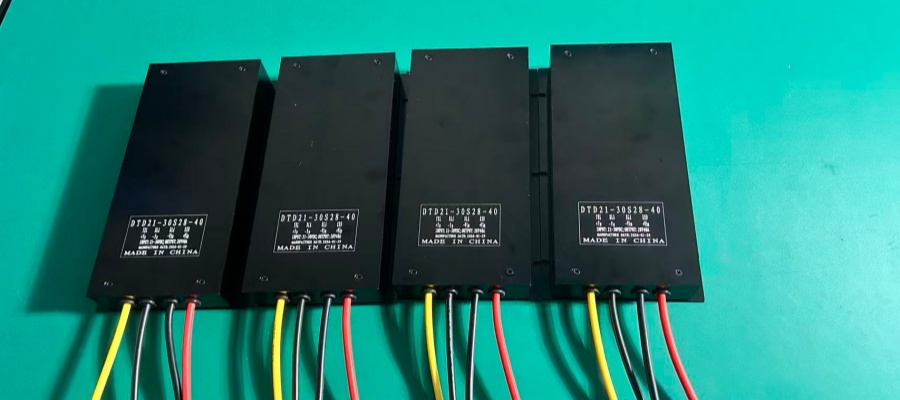
In an industrial automation production line, for instance, when voltage spikes occur in the DC bus due to motor startup, the isolated DC-DC converter can filter out such interference and provide a stable DC220V power supply for the robot controller, ensuring that the movement accuracy of the robotic arm is not affected. In contrast, non-isolated DC-DC converters in such scenarios require additional filtering modules to mitigate interference, which instead increases system complexity and cost.
Wide Voltage Range
Non-isolated DC-DC converters have a narrow voltage regulation range and can usually only be adjusted slightly near the fixed input voltage. If applied in scenarios where the input voltage fluctuates significantly or multiple output requirements need to be met, it is often necessary to replace equipment of different models. Isolated DC-DC converters, relying on the turns ratio adjustment of transformers, can achieve a wider voltage adaptation range. They can not only convert a 1500V DC high-voltage bus to 110V DC for emergency power supply but also reduce a 750V DC rail transit bus to 220V DC for powering passenger information systems, without the need for frequent equipment model replacement.
This adaptability is particularly evident in ship power supply systems: the ship's DC bus voltage may fluctuate within a certain range due to load changes, and the isolated DC converter can dynamically adjust the output to provide stable power to different low-voltage loads such as navigation equipment and communication modules. With the development of power electronics technology, the size and cost of isolated DC converters have been significantly optimized, and they are no longer the "bulky and expensive" option of traditional perception. Instead, they can reduce overall system costs by reducing the number of required adaptation devices.
IDEALPLUISNG Power Expert:
We focus on the research and development, sales and services in the fields of DC-DC power modules, AC-DC rectifier modules, DC-AC inverters, AC power supplies, DC power supplies, LED power supplies, chargers, rectifier systems, etc., providing personalized, efficient, reliable and cost-effective power solutions for all walks of life.
Thank you for considering our services.