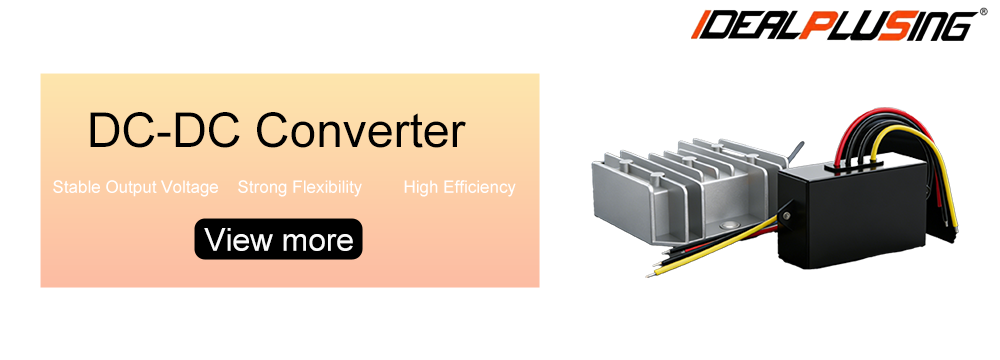
In core scenarios such as industrial automation, new energy power generation, rail transit, and smart manufacturing,DC-DC converters serve as the "core hub" for energy conversion and distribution. Their power supply stability directly determines the continuous operation capability and operational accuracy of entire production lines and equipment. Industrial environments differ from the mild working environments of consumer electronics products. They are typically characterized by extreme conditions such as high temperature, high humidity, strong electromagnetic interference, and severe voltage fluctuations. This places very stringent requirements on the anti-interference capability, reliability, and fault tolerance of DC-DC converters. So what design and technical means can industrial-grade DC-DC converters use to achieve stable power supply with high reliability all day long?
I. Component Selection: Laying a Solid "Hardware Foundation" for Stable Power Supply
The complex operating conditions of industrial scenarios first impose requirements of high temperature resistance, high voltage resistance, and low loss on the core components of DC-DC converters. The rationality of component selection directly determines the basic stability of the equipment.
A big improvement comes from using semiconductor parts that can handle a wide range of frequencies. The old parts made from silicon like IGBTs have limitations because of what they're made of. Wide-bandgap semiconductor components are better than silicon-based IGBTs. Traditional silicon-based IGBTs do not work well when it is very hot or when they have to switch on and off fast which makes it tough for them to keep working properly over a long time in places, like factories that need wide-bandgap semiconductor components to work reliably. When we look at options, silicon carbide and gallium nitride are now the favorite for industrial grade DC-DC converters. This is because silicon carbide and gallium nitride have physical characteristics than other materials. Silicon carbide and gallium nitride are really good, at handling jobs. Take SiC devices for instance. Their bandgap width hits 3.26 eV, and they can operate at temperatures above 200°C. This figure far exceeds the 125°C maximum operating limit of silicon-based components. Additionally, SiC devices boast several key advantages: low on-resistance loss, high switching frequency, and strong voltage resistance.The high-power fuel cell DC-DC converter developed by CRRC Electric based on SiC has a switching frequency increased by more than 4 times, a system average efficiency exceeding 97%, and a maximum efficiency of up to 99%. Even under the high-temperature and high-voltage operating conditions of hydrogen energy vehicle power systems, it can still maintain stable output and has successfully achieved commercial application.
In addition, the selection of passive components should not be overlooked. Industrial-grade DC-DC converters need to use high-frequency electrolytic capacitors with a temperature resistance rating of ≥125°C, low-loss magnetic core inductors, and matching high-precision sampling resistors and industrial-grade driver chips. This ensures that component parameters do not drift and performance does not degrade in extreme environments, avoiding power supply interruptions caused by component failure at the hardware level.
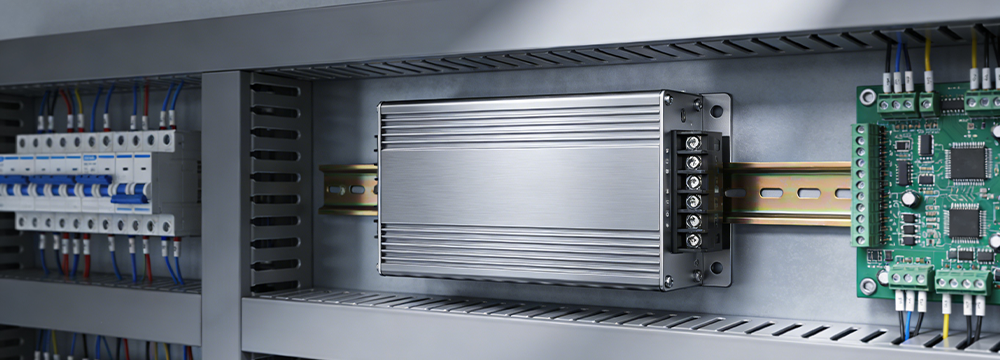
II. Circuit Topology and Filter Design: Suppressing Disturbances and Ensuring Output Accuracy
Industrial power grids often have problems such as large voltage fluctuations and severe harmonic interference. At the same time, the switching actions of the converter itself will generate electromagnetic interference (EMI), affecting the stable operation of itself and surrounding equipment. By optimizing circuit topology and strengthening filter design, internal and external disturbances can be effectively suppressed, ensuring the precise stability of output voltage/current.
Optimized adaptation of topology structure is the core. To meet the high-power and high-reliability requirements of industrial scenarios, phase-shifted full-bridge topology and LLC resonant topology have become mainstream choices. The phase-shifted full-bridge topology adjusts the output voltage by regulating the conduction phase of switching transistors, featuring low switching loss and a wide output range, which can effectively cope with large fluctuations in input voltage. The LLC resonant topology achieves zero-voltage switching (ZVS) by virtue of resonant characteristics, significantly reducing switching loss, and also has the advantages of strong anti-interference ability and small output ripple, making it suitable for the power supply needs of industrial precision equipment. For scenarios requiring multi-channel output and redundant backup, parallel current-sharing topology can also be adopted, which realizes balanced current distribution among multiple modules through current-sharing chips, avoiding overload failure of a single module.
Multi-layer filter mechanism is a key means to suppress disturbances. The input end needs to be equipped with a combination of EMI filter, common-mode inductor, and electrolytic capacitor to filter out differential-mode and common-mode interference in the power grid and absorb transient fluctuations of input voltage. The output end adopts an LC filter circuit combined with ceramic capacitors to reduce output ripple caused by switching actions, controlling the ripple coefficient within 1% to meet the power supply purity requirements of industrial precision control equipment.
III. Comprehensive Protection Mechanisms: Coping with Extreme Conditions and Improving Fault Tolerance
Industrial scenarios have many uncontrollable factors, such as frequent faults like short circuits, overloads, overheating, and overvoltages. DC-DC converters need to have perfect protection mechanisms to respond quickly when faults occur, avoid component damage, and ensure power supply continuity as much as possible.
Multi-level fault protection functions are the core guarantee. The converter is internally integrated with functions such as over-temperature protection (OT), over-voltage protection (OVP), over-current protection (OCP), short-circuit protection (SCP), and reverse connection protection. High-precision sensors collect temperature, voltage, and current signals in real time. Once parameters exceed the safety threshold, the drive circuit immediately turns off the switching transistors or triggers current limiting mode, and automatically resumes operation after the fault is eliminated. For high-temperature operating conditions, in addition to selecting high-temperature resistant components, an intelligent heat dissipation system is also equipped. Through temperature sensors linked with fan speed regulation or liquid cooling, the operating temperature of components is controlled within a safe range, avoiding performance degradation caused by heat accumulation.
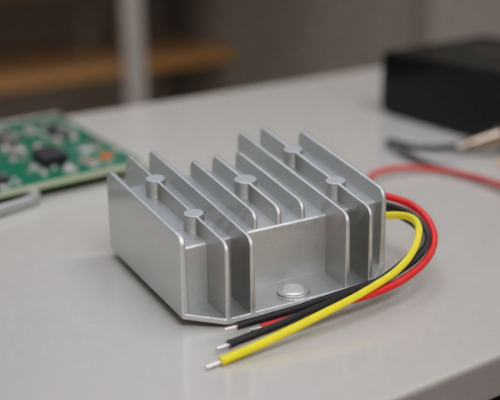
IV. Digital Control and Operation & Maintenance: Real-Time Monitoring and Predicting Potential Risks
As Industry 4.0 advances, digital control has emerged as a vital method to enhance the power supply stability of DC-DC converters. Real-time monitoring, data analysis, and remote operation and maintenance are key approaches here. They enable early detection and handling of faults, thereby lowering the risk of unplanned downtime.
Built-in high-precision monitoring and control chips are the foundation. Industrial-grade DC-DC converters are equipped with microcontrollers (MCUs) or digital signal processors (DSPs), which collect key parameters such as input/output voltage, current, component temperature, and fan speed in real time, and dynamically adjust the output through closed-loop control algorithms to ensure parameter stability. At the same time, the chip has a fault diagnosis function, which can accurately locate fault types (such as component overheating, input overvoltage, output short circuit) and issue alarm signals through indicator lights and buzzers.
Networked operation & maintenance and data traceability expand the control boundary. DC-DC converters supporting industrial communication protocols such as Modbus, CAN, and EtherNet/IP can be connected to the Industrial Internet of Things (IIoT) system to realize remote monitoring, parameter configuration, and fault diagnosis. Operation and maintenance personnel can view the real-time operation status of equipment through the background system, predict potential faults (such as capacitor aging and reduced heat dissipation efficiency) based on historical data trend analysis, and carry out maintenance in advance, transforming passive maintenance into active operation & maintenance, and greatly improving the stability and availability of the power supply system.
Conclusion
The stable power supply of DC-DC converters in industrial scenarios is the result of multi-dimensional collaborative optimization of component selection, circuit design, protection mechanisms, and digital control. From wide-bandgap semiconductor devices laying a solid hardware foundation, to topology and filter design suppressing internal and external disturbances, and to comprehensive protection and digital operation & maintenance ensuring fault tolerance, each technology achieves precise breakthroughs targeting the harsh requirements of industrial scenarios. With the rapid development of new energy, smart manufacturing and other fields, higher requirements will be put forward for the stability, efficiency, and intelligence level of DC-DC converters. The in-depth integration of wide-bandgap semiconductor technology, digital control technology, and Internet of Things technology will surely drive industrial-grade DC-DC converters to upgrade in a more reliable, efficient, and intelligent direction, providing a solid energy guarantee for the continuous operation of industrial production.
We at IDEALPLUSING not only provide products, but also strive to provide customers with suitable power supply solutions and quotations.
Our core competitiveness lies in carefully selecting a variety of power supply options to help customers evaluate and choose the most suitable power supply solution.
We can offer AC DC power supply, DC AC inverter, AC AC power source(single phase or 3 phases),AC DC Ground Power Unit...
Share our interesting knowledge and stories on social media