
In today's era of increasingly sophisticated electronic devices, power supply accuracy directly determines the operational stability and performance limits of the equipment. From the chip power supply in smartphones to the power supply in industrial automation systems, all have strict requirements for the accuracy of voltage output. As the core hub of power conversion, what "black technologies" do DC-DC converters rely on to hold the key line of defense for power supply accuracy? Today, we will delve into the underlying principles.
First, it should be clarified that the core demand for power supply accuracy is: regardless of input voltage fluctuations, load changes, or external environmental interference, the output voltage of the converter can be stabilized within a preset range, and interference indicators such as ripple and noise are controlled at an extremely low level. To achieve this goal, DC-DC converters need to form a collaborative guarantee from multiple aspects such as topology design, control strategies, and component selection.
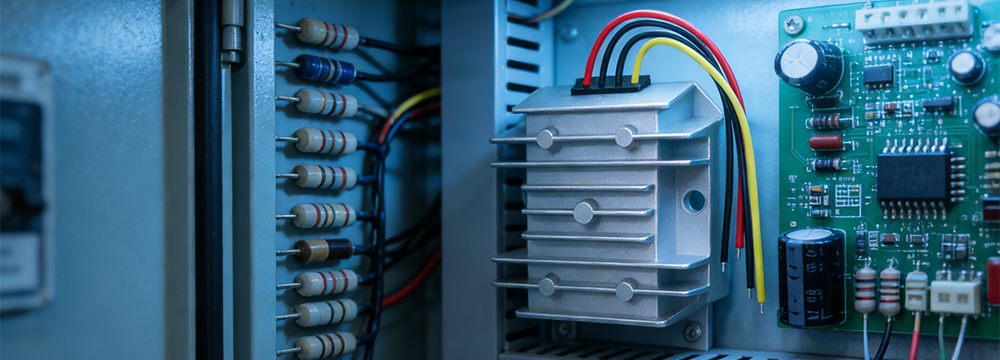
I. Topology Structure: The Basic Framework for Accuracy Guarantee
The topology structure is the "backbone" of a DC-DC converter, and the design logic of different topologies directly affects the difficulty of achieving power supply accuracy. For scenarios requiring high-precision power supply, selecting an appropriate topology is the first step.
For example, the classic Buck (step-down) topology can effectively smooth the voltage fluctuations caused by switching actions through the energy storage and filtering characteristics of inductors and capacitors, making it particularly suitable for low-ripple, high-precision step-down power supply requirements. For scenarios that require a wide input range and stable output, topologies such as SEPIC and Ćuk are more advantageous—when the input voltage fluctuates greatly (such as voltage fluctuations caused by changes in sunlight in solar power supply scenarios), they can achieve a smooth transition of output voltage through the coupled design of capacitors and inductors, avoiding the direct transmission of input fluctuations to the output terminal which would affect accuracy.
In addition, isolated topologies (such as Flyback and Forward) achieve electrical isolation between input and output through transformers. This not only prevents external power grid interference from being transmitted to the load terminal but also optimizes the voltage regulation accuracy through the winding design of the transformer. This is also the key reason for their wide application in chargers for precision electronic equipment.
II. Core Control Strategies: The "Intelligent Brain" for Accuracy Regulation
If the topology is the backbone, then the control strategy is the "brain" of the DC-DC converter and the core driving force for ensuring power supply accuracy. Currently, the mainstream high-precision control strategies are mainly divided into the following categories:
1. Pulse Width Modulation (PWM) Control: This is the most basic and commonly used control method. It accurately controls the average value of the output voltage by adjusting the on-time (duty cycle) of the switching transistor. For example, when the output voltage is lower than the preset value, the controller will automatically increase the duty cycle to allow more electrical energy to be transmitted to the output terminal; otherwise, it will decrease the duty cycle. To improve response speed and regulation accuracy, modern DC-DC converters mostly adopt improved PWM strategies such as peak current control and average current control, which can respond more quickly to transient changes in the load.
2. Pulse Frequency Modulation (PFM) Control: In light-load scenarios, PWM control may lead to decreased efficiency due to a fixed switching frequency, thereby affecting accuracy. In contrast, PFM control adjusts the output voltage by changing the switching frequency. It reduces the frequency under light load to reduce switching losses while maintaining the stability of the output voltage. This "on-demand adjustment" method allows the converter to maintain high power supply accuracy over the entire load range.
3. Digital Control and Intelligent Algorithms: With the development of chip technology, digitally controlled DC-DC converters have gradually become the mainstream for high-precision power supply. Digital control implemented through microprocessors or FPGAs can accurately compensate for errors caused by component parameter drift and temperature changes. More advanced intelligent algorithms (such as PID adaptive regulation and model predictive control) can even predict load changes in advance and actively adjust the output voltage, controlling errors at the millivolt or even microvolt level to meet the power supply requirements of precision components such as chips and sensors.
III. Key Component Selection: The "Precision Parts" for Accuracy Guarantee
No matter how excellent the topology and control strategy are, high-quality components are required to implement them. Key components in DC-DC converters, such as inductors, capacitors, switching transistors, and sampling resistors, directly affect the final performance of power supply accuracy.
As an energy storage component, the stability of the inductor's inductance value and the size of its Equivalent Series Resistance (ESR) are crucial. High-precision inductors can reduce current fluctuations and lower ripple voltage; capacitors with low ESR can quickly filter out high-frequency noise, making the output voltage smoother. The switching speed and on-resistance of switching transistors also affect accuracy—high-speed, low-loss MOSFETs can reduce voltage spikes during switching, avoiding interference with output accuracy.
In addition, the accuracy of the sampling resistor directly determines the accuracy of the controller's judgment on the output voltage. High-precision, low-temperature-drift sampling resistors can ensure that the controller obtains real output voltage data, thereby issuing accurate regulation commands. In some ultra-precision scenarios, a differential sampling method is also adopted to further suppress common-mode interference and improve sampling accuracy.
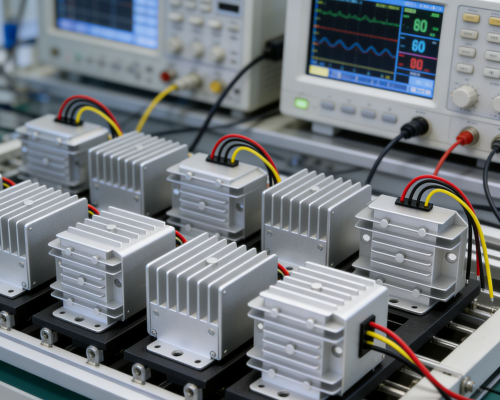
IV. Anti-Interference Design: The "Protective Barrier" for Accuracy Guarantee
Electromagnetic Interference (EMI) from the external environment is an "invisible killer" affecting power supply accuracy. To resist interference, DC-DC converters build protective barriers from aspects such as circuit layout and shielding design.
In terms of PCB layout, the converter adopts a design that separates the "power ground" from the "signal ground" to avoid large current in the power loop interfering with the sampling and control circuits in the signal loop; key signal lines are shortened in length and reduced in bends to lower electromagnetic coupling interference. For industrial scenarios with severe interference, the converter is also equipped with a metal shield to block the intrusion of external electromagnetic radiation; at the same time, EMI filters are added at the input and output terminals to filter out high-frequency interference generated by the power grid or load, ensuring the purity of the output voltage.
V.Conclusion: Technical Collaboration Behind Accuracy
It is not difficult to find that the ability of DC-DC converters to ensure power supply accuracy does not rely on a single technology, but on the all-round collaboration of topology design, control strategies, component selection, and anti-interference design. From basic hardware design to intelligent algorithm regulation, optimizations in every link contribute to "precision power supply."
With the development of new energy, AI, precision manufacturing and other fields, the requirements for power supply accuracy are constantly increasing, which also drives the continuous iteration of DC-DC converter technology—more intelligent control algorithms, more efficient component materials, and more compact integrated designs will all push power supply accuracy to new heights. And all of this will ultimately empower various electronic devices to operate in a more stable and efficient state.
We at IDEALPLUSING not only provide products, but also strive to provide customers with suitable power supply solutions and quotations.
Our core competitiveness lies in carefully selecting a variety of power supply options to help customers evaluate and choose the most suitable power supply solution.
we can offer AC DC power supply, DC AC inverter, AC AC power source(single phase or 3 phases),AC DC Ground Power Unit...
Share our interesting knowledge and stories on social media