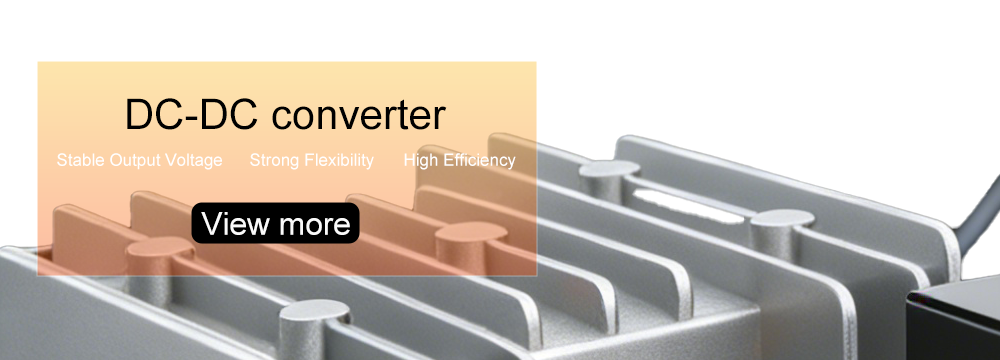
In the evolution of power electronics technology, DC-DC converters have always been a core cornerstone. From meeting basic power conversion needs in the early days to becoming the intelligent hub of digital power systems today, their role transformation not only witnesses the iteration and upgrading of power technology but also closely aligns with the urgent demand for efficient, reliable, and intelligent power supply across various industries. In the digital power era, DC-DC converters have long transcended the limitation of being "pure power conversion tools" and evolved into the intelligent management core throughout the entire lifecycle of power system design, operation, and maintenance. Their evolutionary path clearly outlines the transformation trajectory of power electronics technology from "function-oriented" to "value-oriented."
I. Function Implementation Stage: The "Basic Executor" of Power Conversion
In the early days when digital technology had not yet deeply penetrated the field of power electronics, the core mission of DC-DC converters was extremely simple—to achieve the basic function of "voltage level conversion." At that time, terminal products such as industrial equipment and consumer electronics only required "stable power supply" from the power source. As long as they could convert the input DC voltage into the target voltage required by the load and meet basic ripple and efficiency requirements, they could fulfill their "mission."
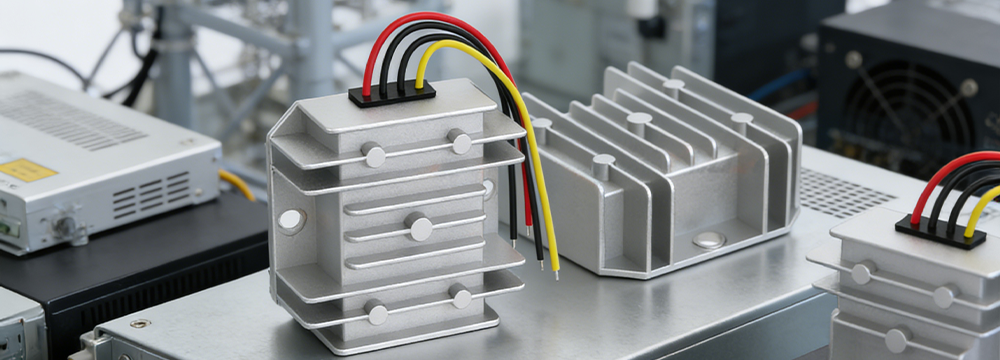
DC-DC converters at this stage were dominated by analog control, with relatively simple circuit designs. The core components were built around basic elements such as power switches, inductors, and capacitors. Their working modes were fixed, and parameter adjustment relied on manual knobs or hardware jumpers, lacking flexibility. For example, in the power adapters of early desktop computers, DC-DC converters only converted the high-voltage DC after mains rectification into 12V, 5V, and 3.3V DC voltages required by motherboards, hard disks, and other components. Once factory-set, key parameters such as output voltage and protection thresholds were almost unadjustable, let alone data interaction and intelligent adaptation.
In application scenarios, such DC-DC converters were more like "passive executors": inputting fixed-specification power and outputting preset voltages. Their ability to adapt to external environmental changes (such as input voltage fluctuations and sudden load changes) was limited, and only rough voltage compensation could be performed through simple feedback circuits. At this time, the core of power system design was "meeting functions," and the value of DC-DC converters was only reflected in "whether power conversion could be achieved," not "how to achieve conversion efficiently and intelligently."
II. Transitional Stage: The "Flexible Adapter" Empowered by Digitization
With the rise of semiconductor technology and digital control technology, the power electronics field began to enter a transitional stage of "digital transformation," and DC-DC converters also shifted from "passive execution" to "flexible adaptation." The core change at this stage was that digital control chips (such as MCUs and DSPs) replaced traditional analog control circuits, injecting a "programmable" gene into DC-DC converters.
The introduction of digital control broke the hardware limitations of DC-DC converter parameter adjustment. Through software programming, users could flexibly adjust key indicators such as output voltage, switching frequency, soft-start time, and protection parameters. For example, in communication base stations, different models of communication modules may require different voltage levels of power supply. Digitized DC-DC converters can switch output parameters through remote commands without on-site manual debugging, greatly improving the flexibility of equipment deployment. In industrial automation scenarios, targeting the dynamic needs of different loads such as motors and sensors, the converter can adjust the response speed in real time to balance efficiency and stability.
III. Intelligent Management Stage: The "Core Hub" of Digital Power Systems
Entering the comprehensive digital power era, the role of DC-DC converters has undergone a qualitative leap, becoming the "intelligent management hub" of power systems. The evolution at this stage is not the enhancement of a single function but a comprehensive upgrade from "individual intelligence" to "system collaboration." Its core value is reflected in four dimensions: efficient optimization, collaborative control, predictive maintenance, and flexible adaptation.
(1) Efficient Optimization: From "Fixed Efficiency" to "Optimal Performance Under All Operating Conditions"
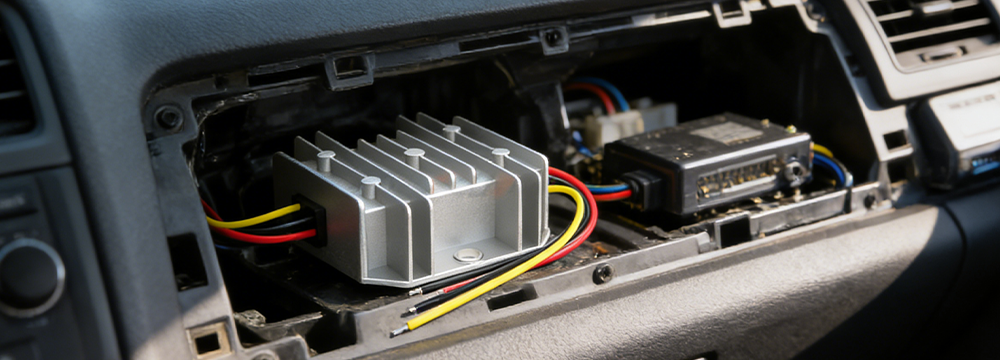
Traditional DC-DC converters have fixed efficiency curves, peaking only under specific load/voltage conditions and dropping sharply in complex scenarios (e.g., light loads, wide input voltages). For new energy vehicles, the converter converts the power battery’s high-voltage DC (300V-400V) to 12V for on-board appliances—with battery voltage varying by remaining charge and loads (air conditioning, lights) fluctuating dynamically. Intelligent converters adapt in real time via algorithms: reducing switching frequency to cut light-load losses and optimizing modulation for heavy-load output, maintaining over 95% efficiency and extending vehicle range.
(2) Collaborative Control: From "Individual Operation" to "System Linkage"
Single DC-DC converters can no longer meet complex power system demands. Digital-era converters integrate with other modules, loads, and management systems via standardized protocols (PMBus, CANopen, EtherCAT), forming distributed intelligent power networks. In data centers, parallel converter modules achieve load balancing, dynamic current distribution, and hot redundancy (load transfer during faults) via communication.
(3) Predictive Maintenance: From "Post-Fault Repair" to "Proactive Early Warning"
Traditional converters rely on post-fault repair, causing downtime and potential system risks. Digital-era models feature high-precision sensors and fault diagnosis algorithms to monitor key components (power switches, capacitors, inductors) in real time. By collecting temperature, voltage/current stress data and applying life models, they calculate remaining component lifespan and send early warnings to upper systems.
(4) Flexible Adaptation: From "Fixed Scenarios" to "Multi-Scenario Compatibility"
Driven by the digital economy, intelligent DC-DC converters offer strong software-defined flexibility for "one hardware, multiple applications." In IoT, they support multi-voltage outputs, pulse power, and sleep-wake modes to adapt to diverse sensor/terminal needs and extend battery life. For IIoT, they auto-identify loads from different manufacturers via protocols and match optimal parameters. In new energy generation, they enable wide input voltage adaptation for solar/wind power, ensuring stable output to storage systems or grids—slashing power product R&D cycles/costs and fostering terminal equipment innovation.
IV. Technological Drivers Behind the Evolution
The role evolution of DC-DC converters from "function implementation" to "intelligent management" is not accidental but an inevitable result of the coordinated development of multiple technologies.
First the big advance, in “digital control technology” is what is really making things happen. The fact that we now have high-performance MCU and DSP chips has made it possible to run complex control algorithms in real time. When we compare control to older analog control, “digital control” is more precise it can be changed more easily and it can resist interference better. This means control gives us the computing power we need to make converters work smarter.
Second the improvement of “sensor technology” has provided the information. Now we have sensors that're very accurate, small and affordable, for measuring voltage, current and temperature. These sensors help “sensor technology” make sure that DC-DC converters can see how they are working and what is happening around them. This gives “sensor technology” a lot of details to make choices.
V. Future Outlook: Smarter, More Integrated, Greener
As 5G and Artificial Intelligence and Internet of Things and new energy technologies get better the DC-DC converters will become even smarter and more integrated and better for the environment. The 5G and Artificial Intelligence and Internet of Things and new energy technologies are really changing things. The DC-DC converters are going to be a part of that. They will be smarter and better, for the environment.
From basic power conversion tools to digital power system hubs, DC-DC converters reflect power electronics’ digital transformation. Today, they deliver reliable, efficient, and intelligent power solutions through optimization, collaboration, predictive maintenance, and flexible adaptation, acting as the "invisible power core" for the digital economy. Future technological breakthroughs will unlock more intelligent scenarios, driving continued innovation in power systems.
Share our interesting knowledge and stories on social media