In medical electronic equipment, the power supply system is a critical component for ensuring the safety of both patients and healthcare professionals. As a key element in the power chain, medical-grade DC-DC converter must not only deliver stable and efficient power conversion but also comply with exceptionally stringent safety and reliability standards. This article provides an in-depth analysis of the special requirements that medical-grade DC-DC converters must meet, with a focus on safety distances (creepage and clearance), isolation ratings, and patient leakage current limits, all interpreted in the context of international standards such as IEC 60601-1.
1. Why Are Medical Power Supplies So Unique?
While standard industrial or consumer power supplies prioritize efficiency, cost, and size, medical devices often make direct or indirect contact with the human body. Any electrical fault—such as electric shock, overheating, or insulation failure—can result in severe injury or even death. Therefore, medical power systems must adhere to the principle of “double protection”, formally defined as:
MOPP (Means of Patient Protection): Protective measures for the patient
MOOP (Means of Operator Protection): Protective measures for the operator
Notably, protection requirements for patients are significantly stricter than those for operators. For example, devices connected to the heart (classified as Type CF) must meet 2 MOPP, the highest safety level in medical power design.
2. Key Safety Requirements Explained
2.1. Isolation Voltage and Insulation Class
Medical DC-DC converters typically require reinforced insulation or double insulation between input and output, or between output and earth (ground).
Basic Requirements:
Input-to-output: ≥ 4 kVAC (tested for 1 minute)
Output-to-ground (patient-connected side): ≥ 1.5 kVAC (for BF/CF applications)
2 MOPP Certification typically demands:
Withstand voltage ≥ 4 kVAC
Creepage distance ≥ 8 mm (Pollution Degree 2, working voltage 250 V)
Clearance ≥ 5 mm
Note: Exact values depend on working voltage, pollution degree (usually Degree 2), and insulation type.
2.2 Safety Distances: Creepage vs. Clearance
These two parameters are often confused but are crucial for safety certification:
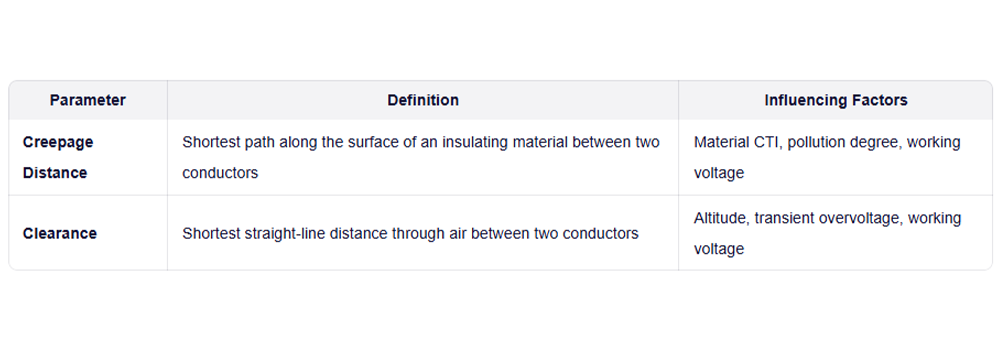
Example (IEC 60601-1 Ed. 3.1, 2 MOPP, 250 V working voltage, Pollution Degree 2):
Creepage distance: ≥ 8.0 mm
Clearance: ≥ 5.0 mm
Using materials with high Comparative Tracking Index (CTI ≥ 600) may allow reduced creepage distances, but medical designs typically adopt conservative margins to ensure safety redundancy.
3. Patient Leakage Current — The Lifeline Specification
This is the most sensitive parameter in medical power design! Leakage current refers to the current flowing from accessible parts of the equipment (especially patient-connected ports) through the human body to ground. Even microamp-level currents can disrupt cardiac rhythm.
Use transformers with minimized inter-winding capacitance
Incorporate electrostatic shields grounded appropriately to suppress common-mode noise
Optimize PCB layout to prevent high-voltage nodes from approaching the output side
4. Biocompatibility and Material Requirements
The DC-DC module does not normally touch the patient.. If the DC-DC module is used in something that people wear or something that is put inside the body the case around the DC-DC module or the materials used to cover it must meet the ISO 10993 biocompatibility standards for the DC-DC module. This is important, for the DC-DC module when it is used in these devices.
All the materials have to be safe from fires. They must meet certain standards like UL 94 V-0. This means the materials must not catch fire easily. The materials also have to keep working when it is very hot and humid. The insulation has to stay intact no what the temperature and humidity are, like. This is very important for the materials to be used. All the materials must meet these standards, including the flammability ratings. They must maintain their insulation integrity when it is hot and humid and that is why the materials must meet the UL 94 V-0 standard.
5. Reliability and Lifetime
Medical devices usually run all the time for years without stopping. So medical grade DC-DC converters must also meet these needs:
MTBF (Mean Time Between Failures) ≥ 100,000 hours
Wide operating temperature range (e.g., –40°C to +85°C)
Strong electromagnetic compatibility (EMC), compliant with IEC 60601-1-2
How to Select a Compliant Medical-Grade DC-DC Converter?
When selecting a converter, verify the following:
Certifications:
Does the product have the IEC/EN 60601-1 Ed. 3.1 Certification?
Is the product certification explicit about having 2 MOPP, for the IEC/EN 60601-1 Ed. 3.1 Certification?
Test Reports: Request third-party safety and leakage current test reports.
So I was wondering about Isolation Construction. Does it have these isolation slots or maybe some reinforced insulation layers?. Maybe it even has these medical-specific transformers that are made just for medical things? I want to know more, about the Isolation Construction in this.
When it comes to power solutions I think it is really important to choose a manufacturer that is credible. I would prefer to buy from vendors that specialize in making power solutions for use. Companies like TDK-Lambda and Mean Well MED series are examples. RECOM and XP Power are also options. These companies are known for making power solutions. I believe that medical power solutions from these vendors are more reliable. So it is better to stick with vendors, like TDK-Lambda, Mean Well MED series, RECOM and XP Power.
A medical-grade DC-DC converter is far more than just an “industrial power supply in a different case.” It is a precision safety device that integrates high-voltage engineering, materials science, biological safety, and electromagnetic compatibility into a compact PCB footprint. Every microamp of leakage current controlled and every millimeter of creepage distance meticulously designed reflects a deep respect for human life.
Share our interesting knowledge and stories on social media