
How Can Manufacturers Achieve Ultra-Low Ripple in High-Performance AC/DC Power Supplies?
In fields such as industrial automation, precision instruments, and high-end electronic equipment, the power supply stability of high-performance AC/DC power supplies directly determines the operational accuracy and service life of end products. As a key interference factor in power output, ripple suppression effect has become a core indicator to measure power supply performance. Ultra-low ripple means that the power output voltage is closer to the ideal DC state, which can effectively avoid problems such as signal distortion and accelerated component loss. Different from conventional solutions such as filter capacitor expansion and topology optimization that are well-known to the public, manufacturers need to adopt more targeted niche technical paths to achieve in-depth ripple suppression while balancing power supply efficiency and cost.
Firstly, the refined design of magnetic components is one of the core links to achieve ultra-low ripple.
This technical direction has not become the mainstream in the industry due to its high requirements for engineering experience and simulation accuracy. In traditional power supply design, magnetic components such as inductors and transformers mostly use standardized magnetic core and winding parameters, which are prone to ripple superposition due to hysteresis loss, leakage inductance and other factors. Manufacturers can improve this situation by customizing magnetic core materials. For example, choosing low-loss nanocrystalline alloy magnetic cores, whose permeability stability is better than ordinary ferrite, can reduce ripples caused by magnetic flux fluctuations in a wide frequency range. At the same time, adopting a segmented winding process, optimizing the number of winding turns and wire diameter ratio according to the current distribution law, reduces spike ripples caused by leakage inductance. The precise simulation of the magnetic field distribution of magnetic components through finite element simulation tools can further avoid ripple mutations caused by magnetic saturation, improving the ripple suppression accuracy by an order of magnitude.

Secondly, the innovative application of adaptive feedback compensation mechanism provides a new technical idea for achieving ultra-low ripple.
Conventional feedback control mostly adopts PID regulation with fixed parameters, which is difficult to adapt to the ripple variation characteristics under different load conditions, especially prone to regulation lag in load mutation scenarios. The niche adaptive compensation scheme implants a high-precision sampling module to capture the amplitude, frequency and phase information of the output ripple in real time, and dynamically adjusts the feedback gain and compensation coefficient combined with the fast computing capability of the digital signal processor (DSP). For example, when detecting that the ripple frequency shifts due to load changes, the system can automatically switch the resonant frequency of the compensation network to ensure that the feedback regulation is always in the optimal state. This technology does not rely on complex peripheral circuits, and can achieve dynamic ripple suppression only through algorithm optimization, which is especially suitable for high-performance power supply products with strict requirements on volume and power consumption.
Furthermore, multi-path energy buffering and cooperative filtering technology breaks the performance bottleneck of a single filtering scheme.
The traditional single-stage filtering structure is often inadequate in the face of wide-band ripples, while the niche multi-path design achieves precise targeted processing by splitting the ripple suppression tasks of different frequency bands. Specifically, for low-frequency ripples, a combination of polymer tantalum capacitors and ceramic capacitors with low equivalent series resistance (ESR) is used, which can quickly absorb voltage fluctuations by utilizing their impedance advantages in the low-frequency band; for high-frequency ripples, planar beads and distributed RC absorption networks are introduced to suppress spike interference caused by switching transistor switching through the high-frequency attenuation characteristics of beads and the damping effect of RC networks. More importantly, the energy coordination of multiple filtering paths is realized through coupled inductors, making different filtering units complementary, avoiding ripple rebound caused by overload of a single unit, and finally achieving effective suppression of full-band ripples.
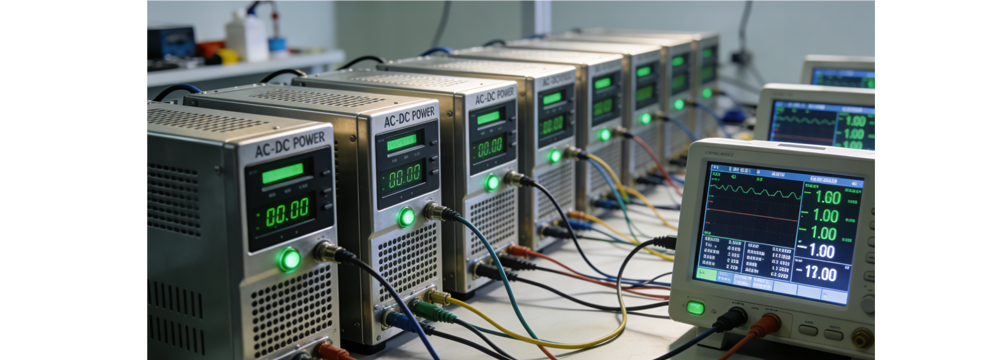
In addition, the electromagnetic compatibility (EMC) optimization of PCB layout is an easily overlooked but crucial link, and the control of its technical details has become the key to distinguishing ordinary power supplies from ultra-low ripple power supplies. Manufacturers can adopt the niche layout strategy of "star grounding + differential routing", concentrating the grounding nodes of the power output terminal, filtering unit and load input terminal at one point to eliminate ripple coupling caused by ground loops. At the same time, shorten the connection length between power devices and filtering components to reduce parasitic inductance and parasitic capacitance, avoiding resonant loops formed by wiring parasitic parameters. Shielded wiring design is adopted on key signal paths to isolate the electromagnetic interference inside the switching power supply from affecting the output ripple. This refined layout design does not require additional hardware costs, but can achieve passive ripple suppression by reducing interference sources and ripple propagation paths, forming a synergistic effect with active suppression technologies.
Achieving ultra-low ripple in high-performance AC/DC power supplies does not rely on the stacking of a single popular technology, but requires manufacturers to delve into niche areas such as custom magnetic components, innovative control algorithms, optimized filtering structures and PCB layout design. Although these technical paths have not become the industry mainstream, they have gradually become the core competitiveness of high-end power supply products due to their strong pertinence and significant effects. With the continuous improvement of terminal equipment's requirements for power supply quality, such niche technologies will gradually mature and be more widely applied, promoting AC/DC power supplies towards higher precision, more stable and reliable development. For manufacturers, delving into these differentiated technologies can not only achieve breakthroughs in product performance, but also establish unique technical barriers in the fierce market competition.
Share our interesting knowledge and stories on social media